
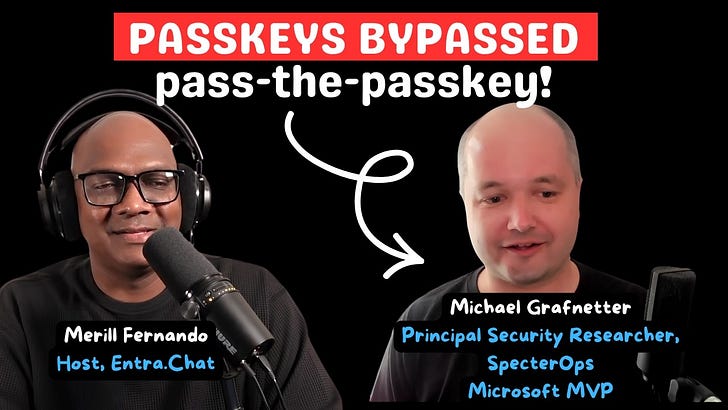

Passkeys are phishing-resistant. But that resistance is enforced by your browser, which binds every authentication to the origin that requested it. Skip the browser, and the guarantee weakens.
In this episode of Entra.Chat, I spoke with Michael Grafnetter, Principal Security Researcher at SpecterOps and Microsoft MVP, about the Pass-the-Passkey research he presented at Black Hat USA 2026. A family of attacks against passkey implementations across Windows, Microsoft Entra ID, browsers and password managers.
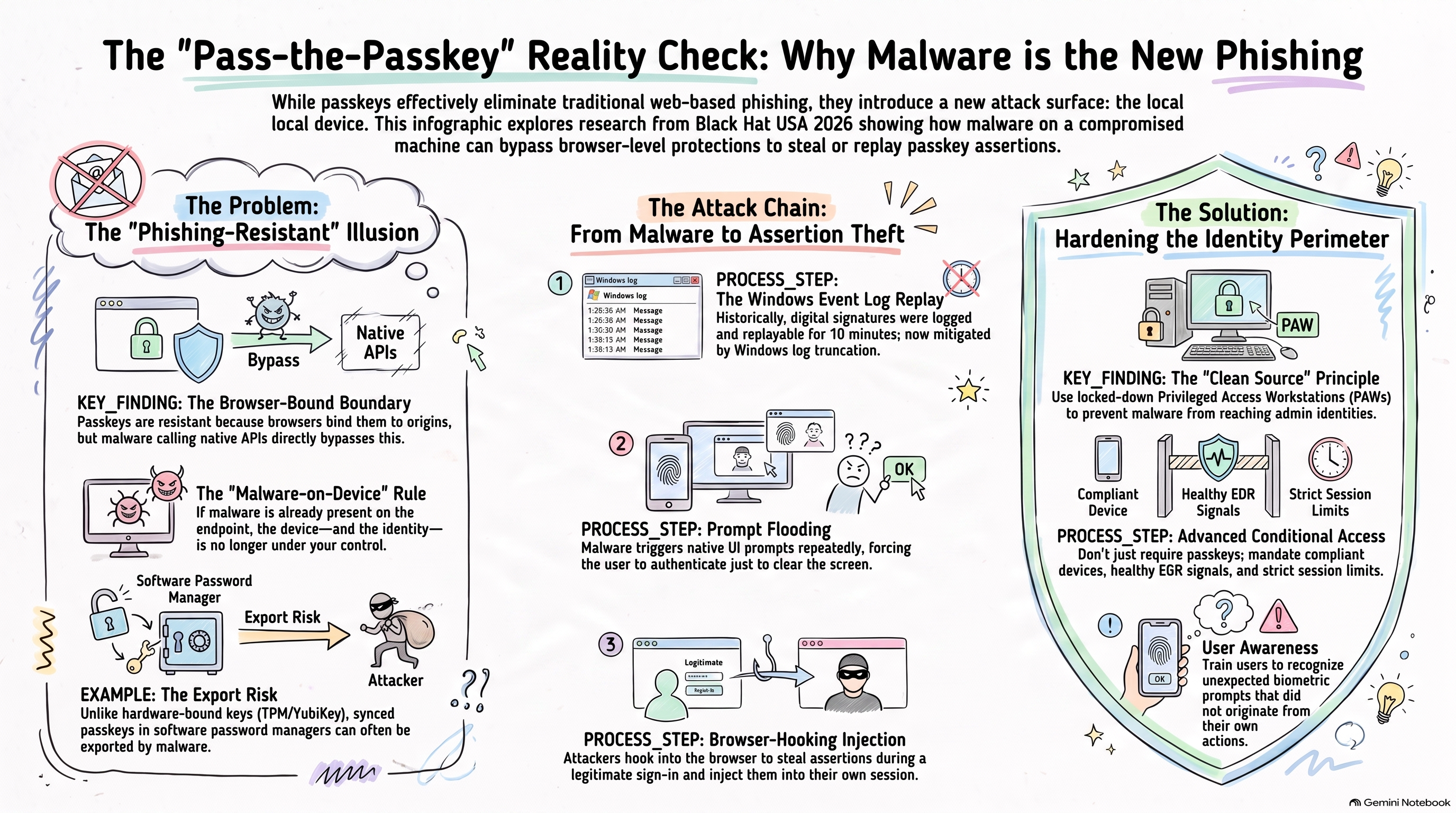
Michael starts with the vulnerability chain he reported to Microsoft. Windows was writing the complete passkey assertion into the event log, and Microsoft Entra ID would accept a replay of that assertion for up to ten minutes. Any user able to read those logs including a member of Remote Desktop Users on a shared server, or unprivileged malware quietly reading event logs without tripping EDR could impersonate whoever had just signed in. If that person was a Global Administrator, so was the attacker. Windows now truncates the logged message, and Microsoft Entra ID checks authenticator signature counters to reject replays.
One clarification Michael is emphatic about: private keys were never written to the event log. They stay bound to the TPM or never leave the security key at all. What leaked were the short-lived digital signatures made by those keys and for this attack, that was enough.
We also covered the attacks that do not depend on any single bug. Malware running without administrator rights can call the native Windows WebAuthn APIs directly and raise a passkey prompt flood that keeps returning until the user gives in and approves it. Synced passkeys, exported from a password manager and decrypted with a keylogged password, hand an attacker a credential with no ten-minute limit at all. And a browser-hooking technique Michael calls a passkey detour attack quietly redirects a legitimate assertion into the attacker’s own session.
The defensive thread running through all of it is the same: every one of these attacks assumes malware is already on the device. That makes device trust the key control. Privileged access workstations for administrators, Conditional Access requiring compliant devices with EDR running, and the clean source principle that says a system can only be as trustworthy as whatever it depends on.
Michael closes on an optimistic note, and it is worth repeating. Passkeys are still the future. They remain far better than passwords and phishable MFA, and every attack here costs an adversary vastly more effort than sending a phishing link. But as passkeys become the default in Microsoft Entra, the threat model deserves an honest read.
Watch the demos. This episode includes three on-screen demonstrations that are much easier to follow on video than on audio.
This episode brought to you by Workplace Ninjas US
Workplace Ninjas US isn’t just another tech conference. It’s where Microsoft experts, MVPs, engineers, and IT professionals come together to learn, network, and build lasting connections.
We are a community built on diversity, mentoring, fellowship, and creating a place where everyone belongs.
Our core DNA comes down to a few pillars:
Over 60 sessions from the largest collection of MVPs and SMEs you will find in any event in America.
Amazing mentoring, development, and growth through our one on one mentoring system with any speaker, our hackathon, community theatre and more.
A diverse expo hall featuring some of the best Microsoft partners in the world that will help you drive deep efficiencies from your M365 stack.
A place where you will learn how to think differently and collaborate better through a collection of activities and can return refreshed and invigorated to drive change in your organization.
Don’t miss out on our early bird tickets while supplies last
Subscribe with your favorite podcast player or watch on YouTube
About Michael Grafnetter
Michael Grafnetter is a Principal Security Researcher at SpecterOps and a Microsoft MVP, based in Prague. He specializes in Microsoft Entra ID and Active Directory security and PowerShell. He is the author of the DSInternals PowerShell module and the researcher who originally discovered the Shadow Credentials attack technique, now widely used by penetration testers, red teamers and attackers alike. He has presented his security research at international conferences including Black Hat Europe, Black Hat USA, SecTor, TROOPERS and BSides Lisbon.
LinkedIn - https://www.linkedin.com/in/grafnetter/
Related Links
Pass-the-Passkey research and tools, including Passkey Injector and the DSInternals.Passkeys module (discussed at 14:57 and 34:22) - https://github.com/SpecterOps/pass-the-passkey
Pass-the-Passkey research paper from Black Hat USA 2026 (introduced at 07:34) - https://specterops.io/wp-content/uploads/sites/3/2026/08/Pass-the-Passkey_A4_v2.pdf
Shadow Credentials, Michael’s earlier Active Directory research (mentioned at 01:46) - https://specterops.io/blog/2021/06/17/shadow-credentials-abusing-key-trust-account-mapping-for-account-takeover/
DSInternals PowerShell module (mentioned at 01:34) - https://www.dsinternals.com/en/
Passkeys (FIDO2) authentication in Microsoft Entra ID (context throughout) - https://learn.microsoft.com/entra/identity/authentication/concept-authentication-passkeys-fido2
Synced passkeys, device-bound passkeys and passkey profiles (discussed at 23:21) - https://learn.microsoft.com/entra/identity/authentication/how-to-authentication-passkeys-fido2
Deploy phishing-resistant passwordless authentication (context at 18:08) - https://learn.microsoft.com/entra/identity/authentication/how-to-deploy-phishing-resistant-passwordless-authentication
Require device compliance with Conditional Access (recommended at 21:12) - https://learn.microsoft.com/entra/identity/conditional-access/policy-all-users-device-compliance
Privileged access devices and the clean source principle (discussed at 21:55 and 35:41) - https://learn.microsoft.com/security/privileged-access-workstations/privileged-access-devices
Unit 42, “Pass the Passkey: A Novel Attack Surface in Passwordless Authentication” — the Palo Alto research on Google Password Manager passkeys (mentioned at 26:27) - https://unit42.paloaltonetworks.com/passwordless-authentication-security-risks/
Related Entra.Chat Episodes
From SMS MFA to Passkeys: A Practical Microsoft Entra Migration Plan - https://entra.news/p/from-sms-mfa-to-passkeys-a-practical
5 Lessons from Rolling Out Passkeys to Millions of Users - https://entra.news/p/5-lessons-from-rolling-out-passkeys
Attackers Are Targeting The AI Ecosystem You Cannot See - https://entra.news/p/attackers-are-targeting-the-ai-ecosystem
Chapters
00:00 Intro
01:02 Meet Michael Grafnetter
03:09 How the Research Started
06:50 Windows Hello for Business Was the First Passkey
07:30 The Signature in Your Event Log
10:18 No, Private Keys Are Not Logged
12:25 How Entra Mitigated the Replay
13:44 Demo: Signing In With a Stolen Signature
15:22 Malware-Initiated Passkey Phishing
18:08 The Browser Is What Makes Passkeys Phishing-Resistant
20:42 What Defenders Should Actually Do
23:04 Synced Passkeys and the Export Problem
26:13 Credential Exchange and Password Manager Risk
28:19 The Passkey Detour Attack
30:43 The Authentication Broker Debate
31:57 RDP Redirection and Remote Passkey Abuse
32:59 Spotting a Suspicious Passkey Prompt
34:46 Passkeys Are Still the Future
Podcast Apps
Apple Podcast - https://entra.chat/apple
YouTube - https://entra.chat/youtube
Spotify - https://entra.chat/spotify
Overcast - https://entra.chat/overcast
Pocketcast - https://entra.chat/pocketcast
Others - https://entra.chat/rss
Merill’s socials
YouTube - youtube.com/@merillx
LinkedIn - linkedin.com/in/merill
Twitter - twitter.com/merill
TikTok - tiktok.com/@merillf
Bluesky - bsky.app/profile/merill.net
Mastodon - infosec.exchange/@merill
Threads - threads.net/@merillf
GitHub - github.com/merill


