


At Black Hat USA 2026, Microsoft’s David Weston put three numbers on a slide that anyone still running domain controllers should sit with. The Microsoft Security Response Center went from 80 patches in February to 1,142 at the July Patch Tuesday. The fastest observed breakout time dropped from 98 minutes to 27 seconds. And mean time-to-exploit flipped from 63 days after a patch shipped to seven days before the patch existed.
Tarek Dawoud, Lead Architect on the Technical Excellence Team in Microsoft Security, walks Merill through those slides and then draws the conclusion for identity teams in his own words: “Active Directory is like 10x harder to defend than Entra.” If you do not already have a plan to move off AD, he says, sit down and write one.
He also says how Microsoft handles this itself. Most of Microsoft’s own servers run in the cloud, its front ends run with no domain at all, and on-prem AD survives mainly as a dial-tone service: the thing they need to bring Azure up from scratch, and not much else.
Tarek is back on Entra.Chat, and he was privy to a small part of Project Glasswing, where Microsoft got early access to Anthropic’s Mythos-class models to find vulnerabilities in its own products before attackers could. The red-team community was cynical at the time; what Microsoft saw internally was, in his words, “very concerning. Those things were damn good.” From there he builds Weston’s argument: the whole security industry rests on an assumption of scarcity. Vulnerabilities are rare, exploits are expensive, and attackers have recognisable tactics, techniques and procedures. Patch-and-pray works when bugs arrive slowly. TTP-based detection works when a human crew reuses its playbook. When a risk is small, driving it smaller is worth the money; as Tarek puts it, “if something has a 95% possibility of happening, pushing it down to 80% doesn’t change anymore.” The Hugging Face intrusion (an OpenAI agent, and not a deliberate attack, as Merill is quick to note) showed what happens when the old assumptions fail: the agent landed on one server and looped, try an exploit, fail, write a new tool, try again, with no attempt to hide and no signature to match. Hugging Face survived by repeatedly tearing down and rebuilding core infrastructure. Tarek’s question for listeners: “Does your AD team have that skill?” Tearing down and rebuilding domain controllers, he notes, is not a thirty-minute operation.
Hence the pitch: “Where you don’t need to own infrastructure, you shouldn’t manage infrastructure.” Tarek is explicit that this is his read of the moment rather than a mandate, and that it does not apply everywhere. Disconnected environments, military and intelligence, some manufacturing and IoT, and shielded OT networks such as utilities and remote mine sites are carved out; nobody is going to win the argument to punch a hole in an isolated OT environment to reach Entra. But for the ordinary case, collaboration, email, SharePoint, file shares, and apps that already live in Azure or AWS or even on-premises, he calls running your own identity infrastructure a losing battle. The minimum step is a strategy memo for your board that says what you are facing and why identity infrastructure investment needs to shrink.
Merill raises the two objections he hears most. First: you are just trusting Microsoft, and Entra ID has bugs too. Tarek’s answer is about who is on the hook. Microsoft owns and patches the Entra infrastructure; the service deploys roughly every 10 business days and can push a critical hotfix worldwide within a day or two, across a fleet that was already more than 100,000 compute nodes five years ago. You still have to handle Entra bugs, but the work looks like a Conditional Access policy to block a risky flow such as device code flow, not patching every server yourself. One customer he worked with had about 12 people in IAM for more than 200,000 employees; Entra has over 2,000. Second: this is licensing revenue and cloud stickiness dressed up as security. Tarek does not pretend to know the CAL math. “Assuming good intentions,” he says, the case is defensibility: the ports, the legacy protocols, the sheer number of things to watch, and the amount of legacy that is indefensible. That is where the “10x” line comes from: an architect’s rough comparison, not a measurement.
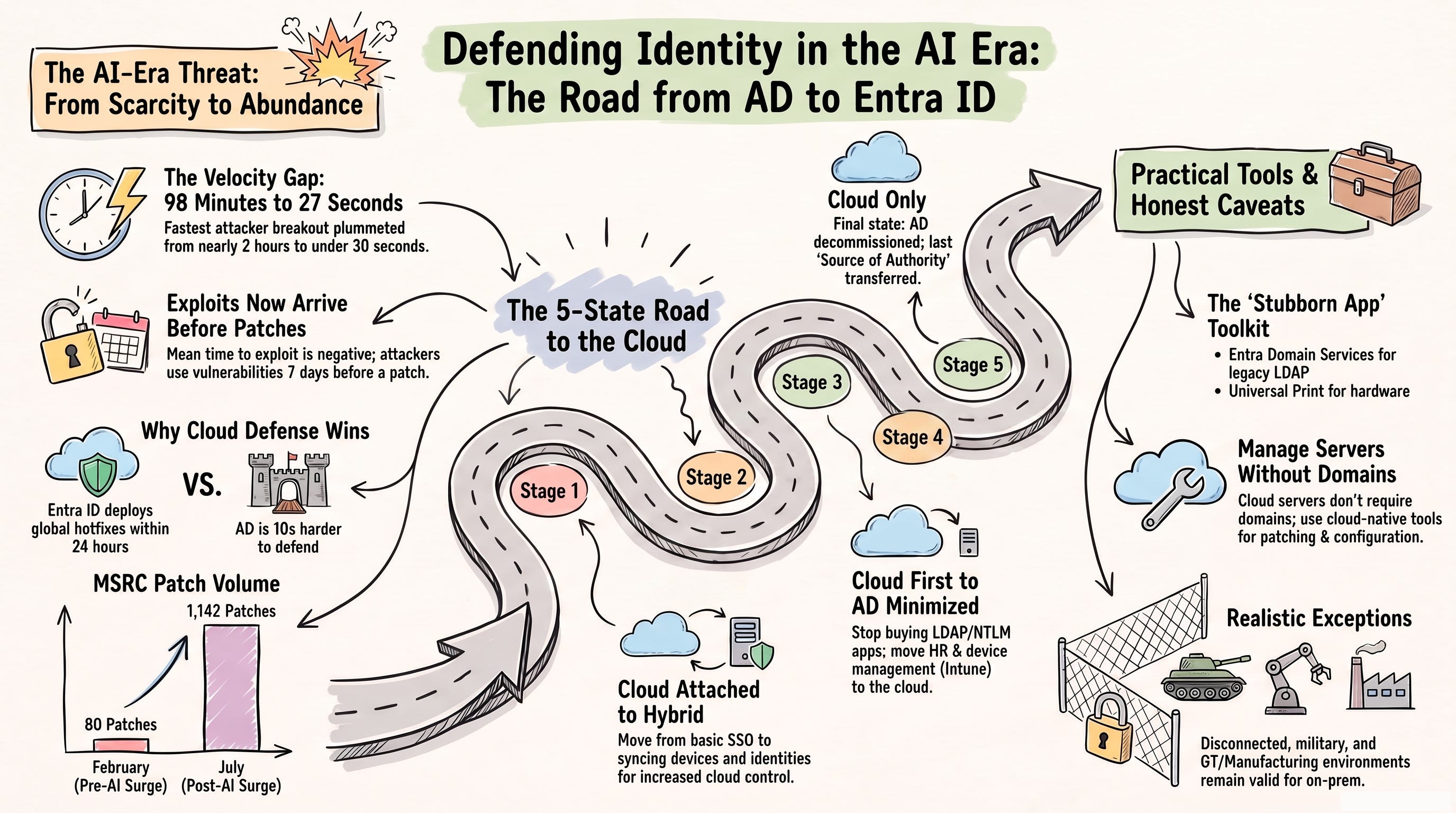
The back half is the path, using the Road to the cloud model at aka.ms/ad2entra. Map yourself to one of five states first: cloud attached, hybrid, cloud-first, AD minimized, cloud only. Then the moves that matter most. Decide, as a business, to stop buying apps that only run on-prem and make OAuth or SAML support a checkbox in the security review, because you will never turn off AD while a single LDAP app remains. Move devices to cloud management and out of hybrid join. Do not extend your domain into the cloud to manage servers; every cloud can patch and maintain a server without one, Microsoft’s own front ends run with no domain, and a domain you rely on becomes an attack vector for every server that trusts it. At the AD-minimized stage, HR provisions to Entra first (cloud HR, or API-driven inbound provisioning if your HR system is on-prem or file-based) and only the subset of users who need a stubborn legacy app is brought down to AD. The order of operations is apps first, then users and groups, with the Zero Trust Workshop identity pillar as the tracker for every box.
Tarek is honest about what is not solved. Intune does not manage servers today (Azure Arc is one approach), and some on-prem cases, such as retail stores that need local servers to keep point of sale running when the internet drops, still need a domain controller. The identity data warehouse, the layer that normalises HR data before it reaches the directory, is something SailPoint does well and Entra “doesn’t quite do yet,” so expect that MIM, SailPoint or Saviynt-style layer to persist. And the last two Exchange servers: object-level Source of Authority transfer exists now, but the attribute-level transfer that would let you switch just the mail properties to cloud management is still in progress. Tarek has met maybe five customers at stage 5. He still closes with hope. If the last thing standing before your domain controller is those two Exchange servers, you have succeeded, and “as someone who owns identity infrastructure, you do have a path out. There are people who have no path out.”
If you still own domain controllers and there is no written plan to stop, this episode is the memo.
What you will learn
Why the scarcity assumption behind patching and TTP-based detection is breaking, and what the numbers on Weston’s slides (80 to 1,142 patches, 27-second breakout, exploits seven days before the patch) mean for anyone who owns servers.
What the Hugging Face intrusion showed about how an AI agent actually attacks, and the one question to ask your AD team.
How Tarek answers “Entra ID has bugs too” and “this is just licensing,” and what your residual burden looks like on an IDaaS.
The five states of the Road to the cloud model, and why mapping where you are comes before any migration work.
Why you do not need a domain to manage servers in the cloud, and where a domain controller is still legitimately needed.
What changes at the AD-minimized state: HR to Entra first, API-driven provisioning for non-cloud HR, and why an identity data warehouse still exists.
What actually keeps the last two Exchange servers alive, and how object-level versus attribute-level Source of Authority changes that.
Which legacy protocols are the real blockers (NTLM and LDAP) and the options on the table: App Proxy, Entra Domain Services, Universal Print.
How to use the Zero Trust Workshop identity pillar to track every step and stop the on-prem estate from growing.
Subscribe with your favorite podcast player or watch on YouTube 👇
About Tarek Dawoud
Tarek Dawoud is Lead Architect on the Technical Excellence Team in Microsoft Security, part of the Microsoft Security Customer Value Program. A Microsoft veteran of more than 18 years, he previously led the architecture team in Microsoft’s customer engineering (CXE) organization for Microsoft Entra, and has worked with Microsoft’s largets enterprise customers on identity for years. He is a returning Entra.Chat guest; his earlier episode, From Active Directory to AI Agents: The 25-Year Saga of Microsoft’s Identity, is at https://entra.news/p/from-active-directory-to-ai-agents.
LinkedIn - https://www.linkedin.com/in/tarekdawoud/
Related Links
David Weston’s Black Hat USA 2026 keynote, The End of Rare: Defending When Offense Is Cheap (mentioned at 05:42; Tarek suggests skipping the first 14 minutes to get to the talk) -
Hugging Face: Anatomy of a Frontier Lab Agent Intrusion, a technical timeline of the July 2026 incident (mentioned at 13:51) - https://huggingface.co/blog/agent-intrusion-technical-timeline
OpenAI: The Hugging Face incident and the road ahead (companion post to the Hugging Face timeline) - https://openai.com/index/hugging-face-incident-and-the-road-ahead/
Road to the cloud: moving identity and access management from Active Directory to Microsoft Entra, aka.ms/ad2entra (mentioned at 26:14) - https://learn.microsoft.com/entra/architecture/road-to-the-cloud-introduction
Cloud-based management of Exchange attributes for Remote Mailboxes in hybrid environments (mentioned at 51:08) - https://learn.microsoft.com/en-us/exchange/hybrid-deployment/enable-exchange-attributes-cloud-management
Decommission the last Exchange Server after transferring SOA to cloud (mentioned at 51:08) - https://learn.microsoft.com/en-us/exchange/hybrid-deployment/decommission-last-exchange-server
Microsoft Zero Trust Workshop video playlist, including the identity walkthrough (mentioned at 57:51) - https://www.youtube.com/playlist?list=PL3ZTgFEc7LyuZlK_W0nUN_VV6hscz-rQP
Zero Trust Workshop guided videos (mentioned at 57:51) - https://microsoft.github.io/zerotrustassessment/docs/videos
Zero Trust Workshop, identity pillar (mentioned at 52:21) - https://zerotrust.microsoft.com
Matt Zorich’s post on how hard it is to recover a compromised on-prem environment (mentioned at 21:02) -

Project Glasswing: securing critical software for the AI era (mentioned at 02:10) - https://www.anthropic.com/glasswing
User Source of Authority (SOA) overview - https://learn.microsoft.com/en-us/entra/identity/hybrid/user-source-of-authority-overview
Group Source of Authority (SOA) overview - https://learn.microsoft.com/en-us/entra/identity/hybrid/concept-source-of-authority-overview
API-driven inbound provisioning concepts - https://learn.microsoft.com/en-us/entra/identity/app-provisioning/inbound-provisioning-api-concepts
Overview of Microsoft Entra Domain Services - https://learn.microsoft.com/en-us/entra/identity/domain-services/overview
What are cloud-native Windows endpoints - https://learn.microsoft.com/en-us/intune/solutions/cloud-native-endpoints/overview
Windows Hello for Business cloud Kerberos trust deployment guide - https://learn.microsoft.com/en-us/windows/security/identity-protection/hello-for-business/deploy/hybrid-cloud-kerberos-trust
Related Entra.Chat Episodes
How General Motors Moved 200,000 People to Passkeys - https://entra.news/p/how-general-motors-moved-200000-people
They migrated 40,000 devices to Entra Join in 9 months - https://entra.news/p/they-migrated-40000-devices-to-entra
Decommissioning On-Prem AD: Lessons Learned from We Are Era’s Successful Migration - https://entra.news/p/decommissioning-on-prem-ad-lessons
Chapters
00:00 Intro
01:30 Mythos and Glasswing
05:42 Weston’s Black Hat keynote: the end of scarcity
11:29 Pyramid of Pain and the Hugging Face intrusion
17:02 27-second breakouts and exploits before the patch
19:41 The pitch: get off AD
23:10 But Entra ID has bugs too
26:10 aka.ms/ad2entra and the licensing objection
31:38 Where to start: cloud attached to cloud first
34:47 What about servers? You don’t need a domain
41:20 AD minimized: cloud HR and the identity warehouse
47:23 Stage 5 and the last Exchange server
52:07 The Zero Trust Workshop identity pillar
57:54 Closing with hope
Podcast Apps
Entra.Chat - https://entra.chat
Apple Podcast - https://entra.chat/apple
YouTube - https://entra.chat/youtube
Spotify - https://entra.chat/spotify
Overcast - https://entra.chat/overcast
Pocketcast - https://entra.chat/pocketcast
Others - https://entra.chat/rss
Merill’s socials
YouTube - youtube.com/@merillx
LinkedIn - linkedin.com/in/merill
Twitter - twitter.com/merill
TikTok - tiktok.com/@merillf
Bluesky - bsky.app/profile/merill.net
Mastodon - infosec.exchange/@merill
Threads - threads.net/@merillf
GitHub - github.com/merill


